From activation to connection on the Kaituna Awa
Published: June 2, 2026
Over the past two years, Whetū Marewa youth worker, Jesper, has been using an adventure therapy programme to offer a different way to support taiohi who may not thrive in traditional, room-based counselling. This activity has shown that when therapy is relational and placed in nature, something shifts. Young people often show up more fully, develop connections faster, and practise regulation skills in real time.
While rafting is the main feature of the day, adventure therapy is much more than a single activity. The programme is supported by a series of intentional exercises designed to build rapport, prompt connection, and support reflection and integration. The rafting becomes the “peak” experience within a wider therapeutic arc. Preparation and post-activity processing are just as important as the time on the river.
Each programme day is rooted in experiential learning. We begin with icebreakers to bring some calm, some laughter and a sense of connection. Then, we establish a Full Value Contract, where the group agrees on how we’ll treat each other, keep each other safe, and communicate. This foundation is crucial as it sets the tone for a respectful and supportive experience.
At the rafting base, we slow things down. We reflect on what “safety,” “challenge,” and “panic” feel like in the body and how these experiences connect to the autonomic nervous system. The goal isn’t to diagnose or label, it’s to build language for internal states and give taiohi a practical map for what happens inside them under stress.
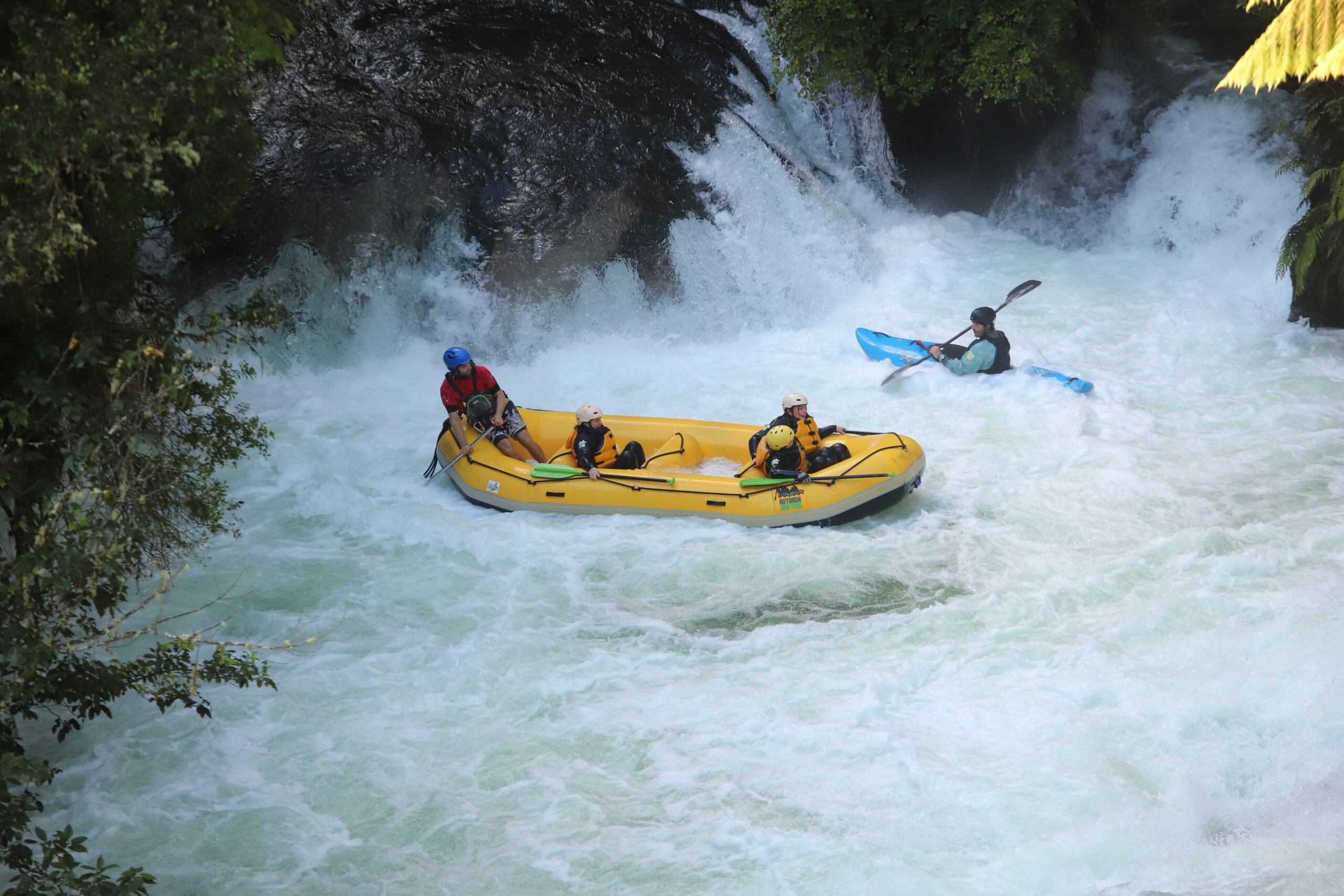
The core activity is whitewater rafting on the Kaituna Awa, including a run down Tutea Falls (the highest commercially rafted waterfall in the world). Taiohi are invited to challenge themselves but never forced. Before the waterfall, participants can choose to continue down the falls or take the walking track around it. This is an important element that supports autonomy, consent, and safety.
From practice observations and my recent social research project, a clear pattern emerges. Participants described Tutea Falls as a key moment of nervous system activation. Usually this looks like fear, racing hearts, and intense anticipation. What stood out wasn’t this feeling itself, but what happened next. With clear structure, graded exposure, and trust, participants described settling again and building confidence through repeated, safe experiences.
Just as importantly, the regulation experienced was not just individual. Taiohi described co-regulation through reassurance (“you’ve got this”), humour, shared trepidation, and feeling “not judged.” The group becomes an important part of the safety system. Several participants also highlighted breathing as a practical self-regulation tool, something they could take with them into everyday life.
One of the most meaningful aspects of the programme is how the awa itself shapes the experience. For some taiohi, moments of awe are not just about the vastness of nature, but about feeling like part of something bigger. We acknowledge the cultural significance of the river through tikanga. This involves a kōrero about the awa’s heritage, as well as a karakia before Tutea Falls to honour the area and the people connected to it. This helps frame the day as more than just an adrenaline activity, it is about respecting the awa itself.
In research interviews, taiohi described their ‘awe moments’ which included calm moments just floating, sharing laughs after the challenge, and the feelings of trust and connection established. For one participant, their awe moment became a memory they could return to later under stress. These moments show that meaningful change can happen through experience, reflection and connection.
Adventure therapy doesn’t replace traditional counselling, it expands on it. It offers a way in for taiohi who might otherwise disengage. It supports skills that are hard to teach in theory alone, including noticing activation, staying connected under stress, using breath and focus, trusting others, and the sense that “I can do hard things and come back to calm.”
A special thanks to Rotorua Rafting for partnering with us to provide this amazing opportunity.